Tear Up the Rulebook: Why Australia's Sharpest Casino Players Are Betting on Beautiful Chaos
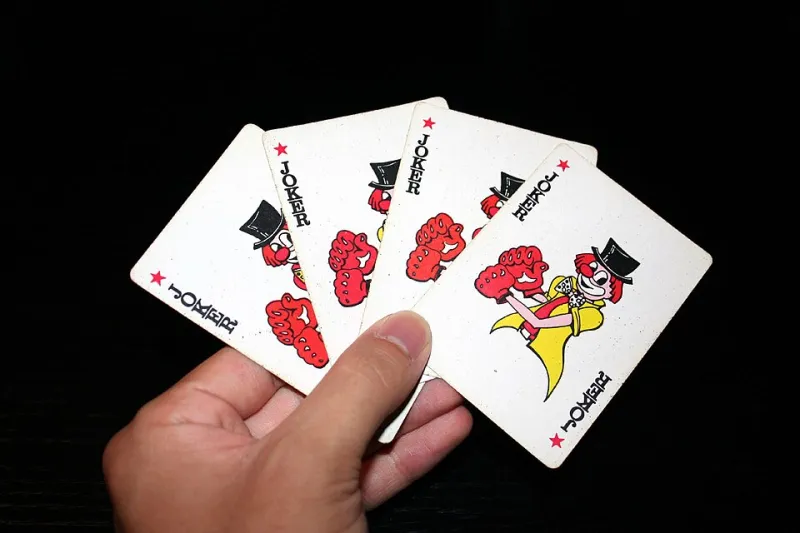
Photo: No machine-readable author provided. Enochlau assumed (based on copyright claims)., CC BY-SA 3.0, via Wikimedia Commons
There's a particular kind of Aussie punter who logs on, pulls up a spreadsheet, sets a rigid betting progression, and follows it with the discipline of a tax accountant during EOFY. Admirable, really. And for a while, it works — until the moment the session decides to go completely sideways and no amount of rigid planning can account for a run of variance that would make a statistician weep into their flat white.
Then there's a different kind of player entirely. One who has a plan, yes — but treats that plan less like a constitution and more like a rough sketch on a napkin. These are the players who've discovered what the joker has always known: sometimes the wildcard is the most valuable card in the deck.
The Problem With Playing It Perfectly Safe
Rigid strategy gets a lot of praise in gaming circles, and honestly, it deserves some of it. Setting loss limits, understanding house edge, sticking to games with favourable RTP — these are fundamentals that separate thoughtful players from people who are essentially making a very expensive donation. Nobody here is arguing against the basics.
But here's where things get interesting. A fixed, formulaic approach assumes the session will behave predictably. It doesn't account for cold streaks that defy probability, bonus rounds that hit at unexpected moments, or the simple psychological reality that humans are not robots — and neither, in a meaningful sense, are the experiences that online casino platforms deliver.
Gaming strategist and long-time Aussie punter Marcus T., who's been playing online for nearly a decade, puts it plainly: "I used to follow my system like gospel. Flat betting, strict session limits, same games every time. And I was fine — but I kept noticing that the moments I actually walked away feeling genuinely good were the times I'd made a call that broke my own rules for a reason I could actually justify."
That phrase — for a reason I could actually justify — is where calculated chaos separates itself from plain old recklessness.
What 'Calculated Chaos' Actually Means
Let's be very clear about something: calculated chaos is not an excuse to punt your entire session bankroll on a hunch because Mercury is in retrograde and your footy team won on the weekend. That's just chaos, full stop.
Calculated chaos is the deliberate, considered decision to deviate from your own established pattern when the conditions genuinely warrant it. It's recognising that strategy should serve the session — not the other way around.
Think of it like this: a good AFL midfielder has a game plan going into every match. But the great ones read the play as it unfolds and adjust in real time. They don't abandon their fundamentals — they adapt them. The same principle applies at the digital felt.
In practical terms, this might look like:
- Shifting volatility mid-session — moving from a high-volatility pokie to a lower-volatility table game when your bankroll has taken a hit and you want to stabilise, rather than doubling down hoping for a big swing.
- Changing your bet sizing deliberately — not chasing losses, but recognising a genuinely favourable moment and choosing to capitalise rather than sticking to a flat-bet system that doesn't account for session context.
- Switching games entirely — sometimes a session on one game is simply not going your way, and the flexible player knows when to walk out of one room and into another, rather than grinding out a bad run on principle.
None of these moves are random. They're responses to real information, made with clear eyes.
The Psychology Behind Breaking Your Own Rules
Here's the genuinely fascinating bit. Research into decision-making under uncertainty consistently shows that rigid adherence to rules in dynamic environments can actually produce worse outcomes than adaptive strategies. The human brain is wired to recognise patterns — and skilled players get very good at reading subtle shifts in a session's rhythm.
This isn't mysticism. It's pattern recognition combined with emotional regulation. The players who do it well aren't acting on gut feelings alone — they're integrating a whole set of signals: how long they've been playing, how their bankroll has moved, what the game's recent behaviour has looked like, and critically, what their own mental state is.
That last one matters more than most people admit. Perth-based player Sasha M. describes it this way: "I know my own tells now. When I start justifying a bet I wouldn't normally make because I 'feel like it's due,' that's not calculated chaos — that's tilt in a fancy hat. Real flexibility feels calm and deliberate. Tilt feels urgent."
The distinction between adaptive strategy and emotional decision-making is the whole game. And developing the self-awareness to tell the difference? That's genuinely a skill that takes time to build.
Why the Joker Is the Perfect Mascot for This Approach
The joker card has always occupied a strange, powerful space in the deck. It doesn't follow suit. It doesn't conform to the hierarchy of numbers and royals. It exists outside the normal rules — and in the games where it's in play, it's often the most powerful card at the table.
That's not a bad metaphor for the kind of player we're talking about. Not someone who ignores the rules, but someone who understands them so thoroughly that they know exactly which ones can be bent, when, and why.
At JokaRoom AU, we've always reckoned that the best gaming experience isn't about rigid systems — it's about bringing your whole, thinking self to the session. The joker doesn't win by being predictable. It wins by being precisely unpredictable at precisely the right moment.
Practical Tips for Building Your Own Adaptive Approach
If this philosophy resonates, here's how to start developing it without just using it as a cover story for impulse decisions:
- Know your baseline first. You can't adapt intelligently from a strategy you haven't fully understood. Build your fundamentals before you start bending them.
- Set conditions in advance. Before a session, decide what would genuinely justify a deviation. "I'll shift to lower-volatility games if I'm down 40% of my session bankroll" is a rule. "I'll change tactics because I feel like it" is not.
- Review your deviations. After a session, look at the moments you broke your own rules. Were they justified? Did they reflect real information or emotional pressure? Be brutally honest.
- Protect your hard limits regardless. Calculated chaos operates within your non-negotiables — session limits, loss limits, time limits. Flexibility lives inside those walls, not outside them.
The best Aussie punters aren't the ones who never deviate from the plan. They're the ones who've built a plan good enough to know exactly when it's worth tearing up — and why.
That's the joker's real wild card. And now you're holding it.